Thursday, July 28, 2011
The 52nd Supplement to the AOU Checklist
The 52nd Supplement is out. Here is the article in The Auk.

Wednesday, July 20, 2011
Camp Birding
What was it like to be outside before I began birding? I often forget, but one measure is how much the simple pleasures of car camping have changed.
Last weekend my family met friends at Lake Dennison Recreation Area in Winchendon. Lovely lake, nice campsites, pretty quiet. That is, until a thunderous Ovenbird woke me at 5am. I wonder how many times I've heard Ovenbirds while camping but not really "heard" them? Here are some of my notes:
Setting up camp: hmm, two pine warblers, red-eyed across the street. Ah, ovenbird very nearby.
Fetching fire wood: red-eyed while driving out, another across the road from where we always buy wood.
Dinner: three pine warblers, actually. Fly-by hairy, distant redbelly.
Next morning, early: teacher-Teacher-TEACHER! Cardinals, a downy rattle, chickadee.
Later, making coffee: the red-eyed is trying to get me to think its a yellow-throated; might have to investigate. White breasted (with all the pines, there might be red breasted about).
Late morning, we hiked up Mt. Watatic. Lovely hike, pretty quiet, until midway: Black Throated Green. Higher: Wood ... no, listen to the ending and cadence ... Hermit!
And then, what you're waiting for, something you don't know. My notes read "tee-tee-[long warble]-trill, a bit buzzy-[shorter warble]-trill-warble. Hmm ... file that away in memory to research later (yes, it was a Purple Finch; mature mixed pine and hardwoods at about 1200ft)
Then, something else I didn't exactly recognize, although it was certainly a warbler: rising zee-zee-tee-tee-zee. That didn't take too much work—it's the alternate song of the BT Green, and there were at least three singing this version (one seen).
Then, before the trees opened onto the summit, another Hermit, close by.
On the summit, kids madly scramble for blueberries, and not a raptor in sight.
Yes, birding changes things.
And as we were packing up, a tiny, nasal toy horn tooted just twice in farewell.
Last weekend my family met friends at Lake Dennison Recreation Area in Winchendon. Lovely lake, nice campsites, pretty quiet. That is, until a thunderous Ovenbird woke me at 5am. I wonder how many times I've heard Ovenbirds while camping but not really "heard" them? Here are some of my notes:
Setting up camp: hmm, two pine warblers, red-eyed across the street. Ah, ovenbird very nearby.
Fetching fire wood: red-eyed while driving out, another across the road from where we always buy wood.
Dinner: three pine warblers, actually. Fly-by hairy, distant redbelly.
Next morning, early: teacher-Teacher-TEACHER! Cardinals, a downy rattle, chickadee.
Later, making coffee: the red-eyed is trying to get me to think its a yellow-throated; might have to investigate. White breasted (with all the pines, there might be red breasted about).
Late morning, we hiked up Mt. Watatic. Lovely hike, pretty quiet, until midway: Black Throated Green. Higher: Wood ... no, listen to the ending and cadence ... Hermit!
And then, what you're waiting for, something you don't know. My notes read "tee-tee-[long warble]-trill, a bit buzzy-[shorter warble]-trill-warble. Hmm ... file that away in memory to research later (yes, it was a Purple Finch; mature mixed pine and hardwoods at about 1200ft)
Then, something else I didn't exactly recognize, although it was certainly a warbler: rising zee-zee-tee-tee-zee. That didn't take too much work—it's the alternate song of the BT Green, and there were at least three singing this version (one seen).
Then, before the trees opened onto the summit, another Hermit, close by.
On the summit, kids madly scramble for blueberries, and not a raptor in sight.
Yes, birding changes things.
And as we were packing up, a tiny, nasal toy horn tooted just twice in farewell.
Sunday, July 3, 2011
Birds of Summer
My family and I were visiting friends in Southampton, Mass, and they live in a lovely, birdy hollow. On a warm, humid afternoon we could hear, but never see Wood Thrush, Veery, Red Eyed Vireos, several Scarlet Tanagers, and of course, the classic bird of summer, the Ovenbird. There were two holding their territories on either side of the stream. One stepped out to see what we were up to.
Happy Fourth!
 |
| click to enlarge |
Happy Fourth!
Wednesday, June 29, 2011
What's in a name?
It's this bird's fault.
Every summer the American Ornithologists' Union announces changes in classification and naming in the July issue of its journal, The Auk. The most anticipated change this July is an overhaul of the Parulidae, the wood warblers. Based on DNA analysis by Irby Lovette (interviewed in Birding), his proposal calls for radical changes to both classification and nomenclature which have been summarized by Kenn Kaufman and David Sibley (see especially his useful visual summary). Let's consider the most interesting change. Here is where our friend Setophaga ruticilla comes in.
A name is an arbitrary signifier; it does not "point" to anything in nature which "requires" that name. But what happens when names change? What happens, as Lovette is proposing, when the Parulas, Hooded Warbler, and American Redstart join the venerable genus Dendroica, which contains everything from Yellow to Kirtland's to Cerulean? This new, expanded grouping would seem to recognize the genetic filiation of these warblers, but are they really closely related? Do they naturally form a genus? As David Sibley comments, "DNA evidence and the resulting 'tree' gives us a fairly objective picture of the relationships within the family, but it’s a complex picture of repeated branching. Converting that information into a few simple categories like families and genera is subjective. Even with all of this data, the decision about where to draw the line when lumping and splitting genera is still arbitrary." American Redstart and Hooded Warbler are not suddenly revealed to be lost cousins, only that they represent, along with the existing members of Dendroica, a grouping of parallel branches of similar "genetic distance" in the family tree of the Parulidae (see Sibley's version of the tree in the AOU proposal).
But the genetic insight of this regrouping is not what's getting all the press. It's the wholesale renaming caused by the inclusion of Northern Redstart. By the rules of priority in nomenclature the inclusion of Setophaga ruticilla, which was named before the genus Dendroica, requires the renaming of the new grouping, the Setophaga. Thus, in one stroke Dendroica is no more. It's a similar story in Wilsonia; having lost Hooded, Wilson's and Canada now join Red-faced, Cardelina rubrifrons, which (you guessed it) also has naming priority. Wilsonia is also no more. All but Bachman's, Blue-Winged, and Golden-Winged leave Vermivora to form a new genus, Oreothlypis. And so on. It's breathtaking.
What's in a name? Everything and maybe nothing. But of course, a warbler by any other name still sounds as sweet.
 |
| American Redstart, Setophaga ruticilla, Oxbow NWR (May 2011) |
Every summer the American Ornithologists' Union announces changes in classification and naming in the July issue of its journal, The Auk. The most anticipated change this July is an overhaul of the Parulidae, the wood warblers. Based on DNA analysis by Irby Lovette (interviewed in Birding), his proposal calls for radical changes to both classification and nomenclature which have been summarized by Kenn Kaufman and David Sibley (see especially his useful visual summary). Let's consider the most interesting change. Here is where our friend Setophaga ruticilla comes in.
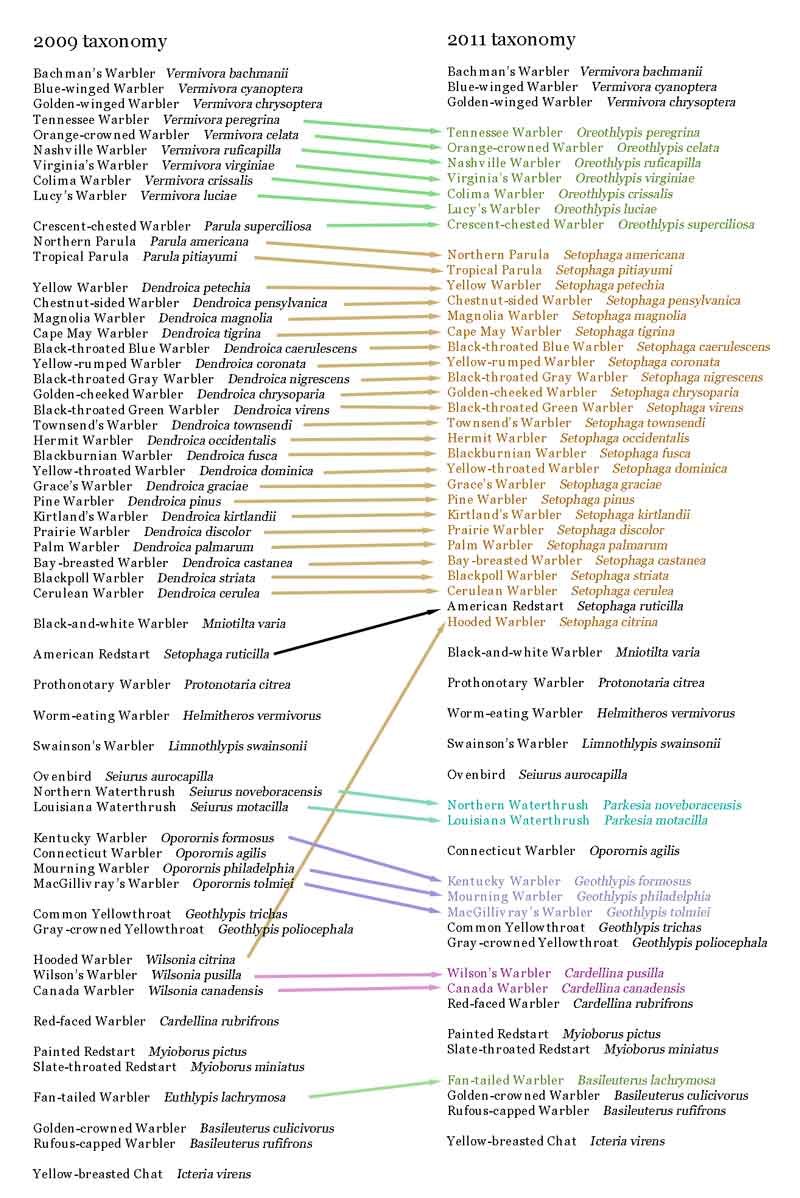
A name is an arbitrary signifier; it does not "point" to anything in nature which "requires" that name. But what happens when names change? What happens, as Lovette is proposing, when the Parulas, Hooded Warbler, and American Redstart join the venerable genus Dendroica, which contains everything from Yellow to Kirtland's to Cerulean? This new, expanded grouping would seem to recognize the genetic filiation of these warblers, but are they really closely related? Do they naturally form a genus? As David Sibley comments, "DNA evidence and the resulting 'tree' gives us a fairly objective picture of the relationships within the family, but it’s a complex picture of repeated branching. Converting that information into a few simple categories like families and genera is subjective. Even with all of this data, the decision about where to draw the line when lumping and splitting genera is still arbitrary." American Redstart and Hooded Warbler are not suddenly revealed to be lost cousins, only that they represent, along with the existing members of Dendroica, a grouping of parallel branches of similar "genetic distance" in the family tree of the Parulidae (see Sibley's version of the tree in the AOU proposal).
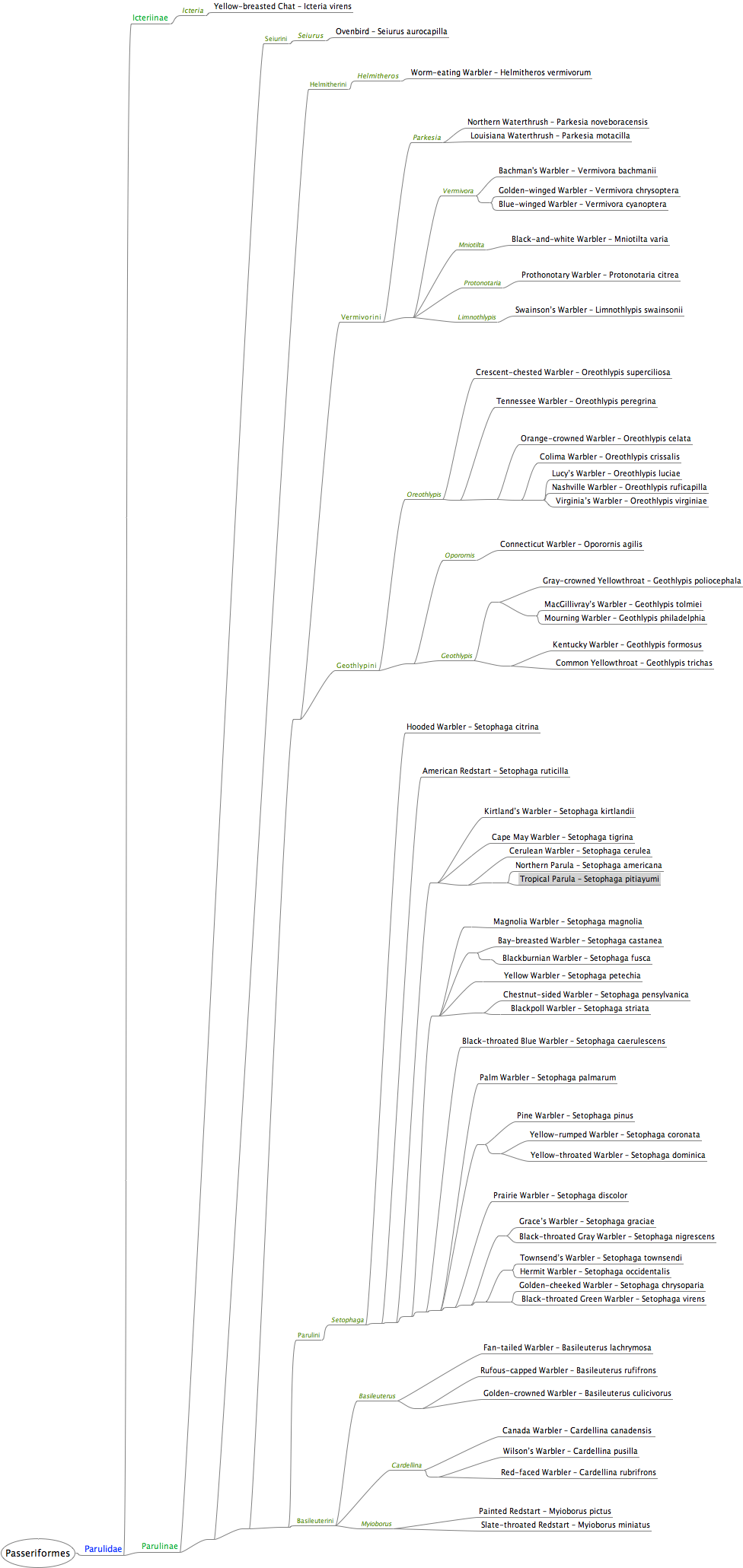
But the genetic insight of this regrouping is not what's getting all the press. It's the wholesale renaming caused by the inclusion of Northern Redstart. By the rules of priority in nomenclature the inclusion of Setophaga ruticilla, which was named before the genus Dendroica, requires the renaming of the new grouping, the Setophaga. Thus, in one stroke Dendroica is no more. It's a similar story in Wilsonia; having lost Hooded, Wilson's and Canada now join Red-faced, Cardelina rubrifrons, which (you guessed it) also has naming priority. Wilsonia is also no more. All but Bachman's, Blue-Winged, and Golden-Winged leave Vermivora to form a new genus, Oreothlypis. And so on. It's breathtaking.
What's in a name? Everything and maybe nothing. But of course, a warbler by any other name still sounds as sweet.
Monday, June 27, 2011
Photo Quiz 0
Every blog begins somewhere. This one begins with a lousy picture (get used to them) that I'm deviously turning into an ID stumper. Surely it is right up there with the tricksy ones the ABA posts. My nine-year-old (who appears to have memorized Sibley) nailed it and named two field marks in 5 seconds. Have at it!
 |
| Shot from the hip, Great Meadows NWR, Concord, MA (June 24, 2011) |
Subscribe to:
Posts (Atom)